Thursday, March 23, 2023

PLAYFUL MATH BLOG CARNIVAL #163

BLOG CARNIVAL #163....LET'S GO!


Fun fact: The number 163 is prime, which we can prove simply by showing that it is not divisible by 2, 3, 5, 7, or 11.  (Of those prime factors, the only one that's a little tricky to check is 7, but I can see that since 140 + 21 = 161 is a multiple of 7, the number 163 is not.). By the way ... why don't I have to check prime factors greater than 11?  Howie Hua gives a nice little video explanation.


First, indulge me while I give a little plug for my own playful math project, a series of free math songs on my YouTube channel called Tunes that Count. We just released a new song about powers of 2 called The Power of Powers.  Check it out!


Now, check out the great things I found below.  Some are perfect little nuggets for use in classrooms or homeschooling. I also found some great math-art project ideas. Enjoy! 


INTERNATIONAL DAY OF MATHEMATICS


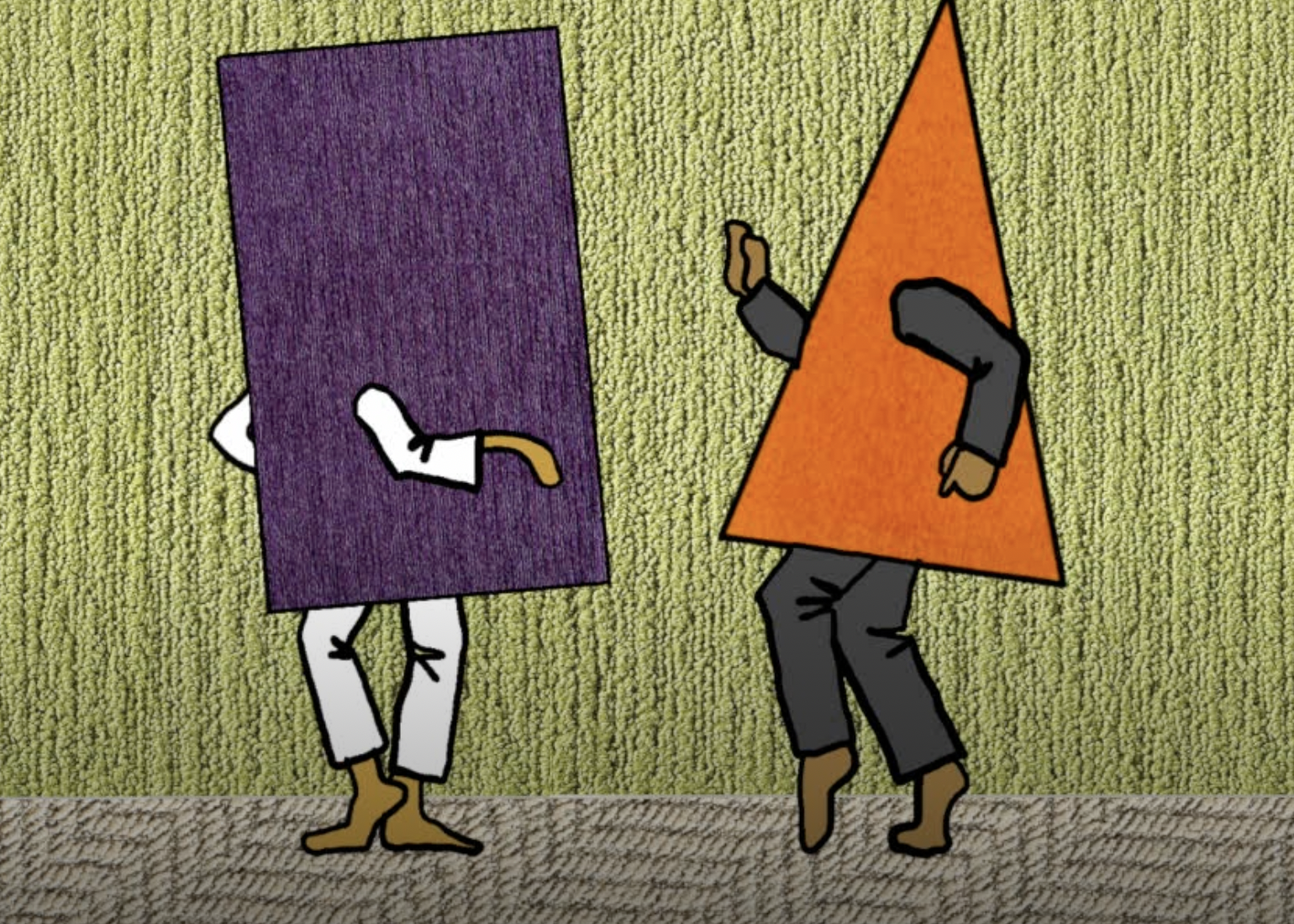
March 14 was Pi Day, of course, but according to UNESCO it is also the International Day of Mathematics. One of the activities that was organized was a mathematics cartoon contest. Children and adults from all over the world entered, and you can see some of the selected cartoons in this gallery. Since the cartoons have no words -- only visuals and mathematical symbols -- the gallery is a testament mathematics as a universal form of communication. Below is one of my favorite of the cartoons, submitted by two students from Colombia.


FRENCH WEEK OF MATHEMATICS


Speaking of playful math....The French Ministry of Education sponsors a "week of mathematics" each year with a different theme in which it encourages people to create and share playful mathematics activities. This year, the "week" of mathematics ran from March 6 to March 15 and had the theme "Mathématiques à la carte." The contribution shown below is a clever game of vector dominoes by Jeux 2 Maths. For more details and for more games see their website. (Many of the games are so visual that you don't need to read French to understand them.) If you want to see more ideas, search for the hashtag #SDM2023 on Twitter.


HAPPY PALINDROME DAY!

NCTM reminded us with a tweet that March 20, 2023 was a palindrome day!  Naturally that raises questions. I wonder how special that is?  Do we get only one per year?  Do we get one every year? 


PLAYFUL CLASSROOM MATH


Math for Love

A recent post from Math for Love helps teachers out with resources to plan a Family Math Night at their school. In general, I love games and puzzles where the rules are simple but the math is not. This blog post offers a nice sample of such games and puzzles. The image below shows one puzzle type (The Broken Calculator), which I think would be perfect for 4th or 5th grade. In fact, I loved the idea so much I created my own version for a 5th grade decimal unit. (For example, how would you make 0.364 without the decimal point and without a 3, 6 or 4? Tricky!) 


Denise Gaskin's Let's Play Math

Denise has been sharing free games and activities from her collection of playful books. One of her books is called "Thinking Thursday: A new math journaling prompt every week!" From this book Denise recently shared the prompt, "Pick a topic you have learned in math. Write two correct statements and one false statement. Trade with a friend. Can you find each other’s fibs?" 


Here's an example of a more targeted prompt: "Tell me two truths and a lie about the median of a set of 5 numbers." If you try it yourself, as I did below, you'll see it's not so easy to write these kinds of statements. Open-ended tasks like this are great for differentiation within a classroom because students will each challenge themselves at an appropriate level.


A.          The median of 5 numbers is always a number in the set.

B.          The median of 5 numbers is always greater than the smallest number in. the set.

C.          The median of 5 numbers does not change if you add 10 to the largest number.


Reflections and Tangents: Thoughts on Math, Education, and Technology

The Reflections and Tangents blog has done a series of posts using what they call the "Same and Different inquiry routine." The idea is that you present students with two similar mathematical situations, and (as the name suggests) ask students to brainstorm how the situations are the same and how they are different. The March 3 blog post gives an example from calculus, but you could really adapt the structure of the activity to any grade level at all. For a middle school classroom, you might ask, for example, what is the same and what is different about 3 different sequences.  


7, 10, 13, 16, . . .

3, 6, 9, 12, 15, . . .

3, 9, 27, 81, . . . 


@Mathgarden

This recent tweet by Sunil Singh sort of blew my mind. He shows a textbook illustration that extends Pascal's triangle upwards to include Row - 1, Row -2, and Row -3. Why didn't I think of this before? Extending the triangle would make a wonderful, playful activity for middle schoolers. For older students, it broadens the application of the binomial theorem to include negative exponents. 


PLAYFUL MATH PROJECTS, PUZZLES, AND GAMES FOR MATH CIRCLES


Playful Bookbinding and Paperworks

This blog is by an artist (Paula Beardell Krieg) who explores mathematics visually.  In a recent post she turns a circle theorem about inscribed right triangles into an art project.  Notice the visual impact of this drawing: In spite of the complexity and asymmetry of the drawing, many of the lines Paula created intersect in what appears to be the center of the circle. The drawing invites you to wonder why!


Julia Robinson Mathematics Festival activities blog

The Julia Robinson Math Festival is always a good source of playful activities. Their new blog for activities that are not quite ready for prime time is a great find. The most recent post on Modular Origami with Sonobe Units is a rich activity that could keep a math circle busy and engaged for a few sessions. The origami squares become building blocks to create polyhedra, which can then be explored geometrically (exploring structures) and algebraically (exploring numerical patterns). 


Early Family Math

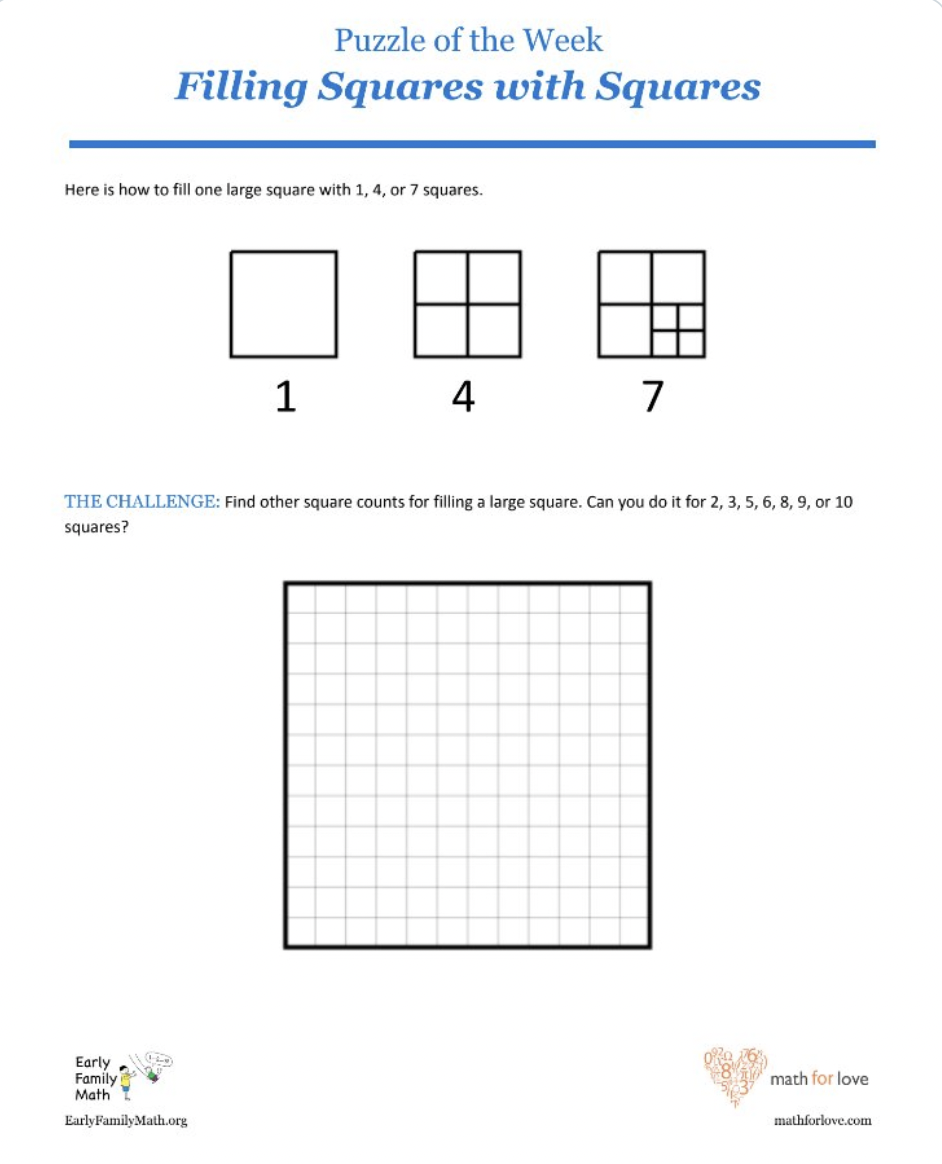
Early Family Math is a resource for playful math activities for families and teachers.  Their recent  Puzzle of the Week is one that I know and love and had forgotten about. 

The idea is so simple.  How many non-overlapping squares can you divide a square into?  What's interesting about the puzzle is that it can be done as a straightforward exploratory exercise with young children. But it can also lead to an informal proof by mathematical induction. For example, I can see below that it is possible to turn 4 squares into 7 squares simply by subdividing one of the squares. But that technique can also be generalized. If I can make 4, then I can make 4 + 3 by subdividing one of the little squares. I can also make 4 + 3 + 3, or 4 + 3 + 3 + 3, and so forth. In fact, I can make any number of the form 4 + 3N  for N greater than or equal to 0.  What other patterns can you find?  Is there some largest number that can't be made?


@sonukg4india
This tweet from the prolific @sonukg4india caught my eye. It gives a beautiful demonstration of the Pythagorean theorem. This one shows a 3-4-5 triangle. What other Pythagorean triples could you build out of blocks in this way?  


Wednesday, November 30, 2022

Why can't I divide by zero?

What is 4 divided by zero?  Some students reason that you can think of it as long division and take out as many zeroes as you like from 4 without ever making 4 smaller.  So maybe 4 divided by zero is "infinity"?


That's not unreasonable.  In fact American textbooks from the 1800s took that point of view.  The image below is from the 1876 edition of Charles Davies algebra textbook, p. 83. He says that a number divided by zero is equivalent to infinity.


The problem with dividing by zero is that it leads to contradictions. If 4 divided by zero is "infinity," then does that mean that infinity times zero equals 4?  

Check out this sweet little song about Zero, which shows the problem.  Zero is powerful, but it is also dangerous. If you are not careful when you divide, you might run into contradictions. You might even break math! Link to video is here.


Wednesday, November 9, 2022

Rectangles and Triangles

Rectangles are so simple.  Their angles are always 90 degrees.  But triangles come in all different shapes. So how do you find the area of a triangle?  

Check out this musical video about the area of triangles:  Rectangles and Triangles


Saturday, October 22, 2022

Map Folding Problem


The lines in the map above show how it was folded.  Dotted lines show a “valley fold” and solid lines show a “mountain fold.”  This map was folded in half horizontally, then vertically, then vertically again.

Question:  Each of the maps below was folded in four steps – in half each time.  Which of the maps is an “impossible map”?


Also check out my new project: musical math videos. Subscribe to the YouTube Channel to get more as they are released!

For the solution to the map problem, click here:

Thursday, October 13, 2022

Prime Time!

A new song!

Welcome to Prime Time Building Supply! Imagine a store  that sells prime numbers. We sell classics like 2, 3, 5, or 7. We also sell the elegant and understated 1009. With our prime numbers, you can build composite numbers of any size!

The song:  Prime Time


Wednesday, October 5, 2022

Gauss’ Trick

I am happy to announce the launch of a new project. This is the first in a series of musical math videos. Please enjoy and share this song about the mathematician Gauss as a little boy and his trick for adding the numbers from 1 to 100.  


Musical video:  https://youtu.be/XlGsUlIEdYc


Companion video explanation of Gauss' method:  https://youtu.be/fTluDWc1v-A


Tuesday, March 15, 2022

Lattice Polygons, Part 2

Lattice polygons are polygons are formed by connecting dots on square dot paper.  (On a coordinate graph, the coordinates of the vertices are integers.). 


The lattice polygon below is a rectangle whose dimensions are 2 units by 4 units.  Its area is 8 square units.

(1)  Can you make a small change to the rectangle so that the area of the new polygon is 6 square units? There are lots of ways to do this.


(2)  How many different kinds of polygons can you make on a geoboard with an area of exactly 6 square units?  Can you make a triangle?  a quadrilateral?  a 5-sided figure?  6-sided?  7-sided?  8-sided?

It is convenient to use this online geoboard:  Geoboard

For the solution, click below:

Thursday, March 10, 2022

Same Sum Circles, Part 2

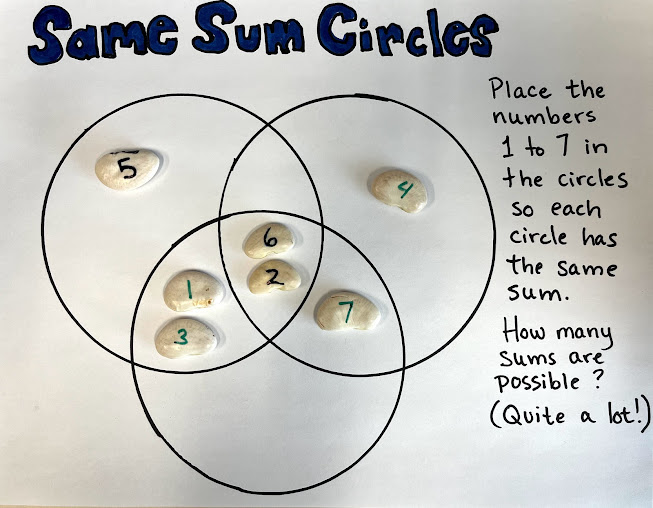
The goal of this puzzle is to place the numbers 1 through 7 in the circles so that you get the same sum in each circle.  

Notice that the placement below is ALMOST a solution but not quite.  One circle has a sum of 17 and the other two have a sum of 19.  You can fix it by moving only one bean.  Which one?  Where would you move it?

Once you figure that out, see how many different sums you can make.  You can make quite a lot!


Click "read more" for the solution:

Sunday, January 30, 2022

The Sock Problem #2

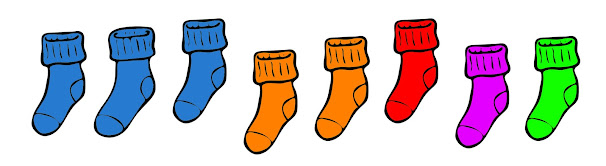
Silas reaches into his sock drawer in the dark, and he wants to make sure that he grabs a matching pair.  The drawer has 3 identical blue socks, 2 orange, 1 red, 1 purple, and 1 green sock. 

Question:  How many socks must Silas grab to ensure that he has at least one matching pair? 

For the solution, click "read more" below:

Wednesday, November 24, 2021

The Stripey Triangle Problem

A triangle is divided into 7 stripes, all the same width and all parallel to the base.  If the small purple triangle at the tip has an area of 3 square units, then what is the area of the largest triangle (the whole thing)?


For the solution, click "Read More" below.

Tuesday, November 9, 2021

The Consecutive Number Problem

Ginger writes down a sequence of numbers. Each is a positive whole number from 1 to 11, and she uses each number only once. Henrietta looks at the sequence and notices that for every pair of numbers next to each other in the sequence, one is divisible by the other. What is the maximum number of numbers that Ginger wrote down?


For the solution, click "Read More" below.

Sunday, November 7, 2021

The Rolling Cube Problem

Cubes that are freshly painted with blue and yellow paint roll along a table and leave paint behind on the table.


Which of the paint trails above could have been made by a cube whose faces were painted with blue and yellow paint?


For the solution, click "Read More" below.

Monday, October 25, 2021

The Birthday Party Problem


Betty’s friends threw her a birthday party. Everyone (including Betty) met exactly 3 new people at the party. 


When Betty told her mom about the party later, her mom said, “That sounds like fun! How many people were there at the party?” 


“I think there were 14, or maybe 15, including me,” answered Betty.


Question: If Betty was right that there were either 14 or 15 people at the party, then which number is correct? 


For the solution, click "Read More" below.

Saturday, October 23, 2021

The Isosceles Triangle Problem

The lines below are parallel. 


If we place a point on the top line, we can connect that point to points A and B to create an isosceles triangle:  (Remember -- an isosceles triangle has two sides of the same length.)

Question:  How many other ways can this be done?  How many distinct isosceles triangles can you make that include points A and B as two of the three vertices?


For the solution, click "Read More" below.

Friday, September 24, 2021

Four fours!

Warm up:

Place operation symbols between the ones to make the equations true.  (Use the four operations and parentheses.)

1    1    1    1    =     0

1    1    1    1    =     1

1    1    1    1    =     2

1    1    1    1    =     3

1    1    1    1    =     4


Work out:

4   4   4   4  =  0 

4   4   4   4  =  1 

4   4   4   4  =  2 

4   4   4   4  =  3 

4   4   4   4  =  4 

4   4   4   4  =  5 

4   4   4   4  =  6 

4   4   4   4  =  7 

4   4   4   4  =  8 

4   4   4   4  =  9 

4   4   4   4  =  10 


For the solution, click "Read More" below.

Thursday, March 25, 2021

Toothpick Puzzle!

This is a repost of a problem from several years ago.  This time I am including an interactive document that you can use to move your toothpicks around and create your figures. First, make sure you are signed in with a Google/gmail account - otherwise you will be able to see the document but can't make your own copy.  Open the document and then under the "file" menu, click "make a copy" to make your own copy:  Toothpick Perimeter document

Here's the problem:

Notice that you can make figures with toothpicks.  We can think of each toothpick as a unit of length.  Below I made a figure with a perimeter of 12 and an area of 9:


Question:  How many different areas can be made with the same perimeter of 12?  (Notice that we can make a perimeter of 8 simply by "bending in" a corner of the figure. The area is smaller but the perimeter is the same.)  What is the smallest area you can make with 12 toothpicks?  The largest?  Can you make every whole number in between?


(This activity was inspired by a puzzle in Kordemsky's The Moscow Puzzles.)

For the solution, click "Read More" below.

Sunday, April 12, 2020

Drafter's Puzzle #2

A solid figure cut out of a cube looks like this in 2 dimensions when viewed from the front, back, and top.  Notice that it has a horizontal edge visible from the front but not from the top.  What could the solid look like?


Notice that it cannot look like this.  Otherwise we would see an edge from the top too!


What does the solid look like?  There are various possibilities.

For the solution, click "Read More" below.

Thursday, April 9, 2020

Spatial thinking challenge

The figures below are all cut out of identical cubes.


The diagram below shows the front view of the figures in two dimensions.


Question:  What would the figures look like from the top in two dimensions?  Strangely, four of them look the same from above.  Which one is different?


For the solution, click "Read More" below.

Tuesday, March 24, 2020

The Funny Calculator

A calculator has these buttons:


Just like a “normal” calculator,  

When you type 1 x 10, it says 10.
When you type 1 + 10, it says 11.

But…

When you type 1 + 1, it says 10.
When you type 10 + 10, it says 100.

--------------------------------------------------------------------------------------------

Using this information alone:

How would you count from one to four?  

What would the calculator say if you typed in 100 10 ?
    

Extending the pattern:


 Can you extend the pattern to count up to twenty?

What would the calculator say if you typed in 0.1 + 0.1?

What would the calculator say if you typed in 0.1 x 10 ?

What would the calculator say if you typed in 111 + 111 ?

What would the calculator say if you typed in 111 x 10 ?

For the solution, click "Read More" below.

PLAYFUL MATH BLOG CARNIVAL #163

BLOG CARNIVAL #163....LET'S GO! Fun fact: The number 163 is prime, which we can prove simply by showing that it is not divisible by 2, 3...